Something big is coming to the music industry. The smart ones have already worked it out, and it scares the crap out of them. The really smart ones are getting ready.
Weird music
When I was young, my parents owned a radio station in Bega. It was great for us kids because all we had to do to listen to music was head down to the station and hang about in the record library. We could take a few records home and tape them too if we wanted.
I discovered some pretty incredible music for a country radio station. Kraftwerk, Devo, Run DMC and more poppy stuff like Frankie Goes To Hollywood and Culture Club.
This is probably how I got into weird music--by having the opportunity to listen to anything I wanted without having to pay for the privelege. When my parents sold the station, I had to buy music and much of the new music I discovered was coming from radio. I went through a pretty dire patch of crap music.
Later in life I was dragged to a rave by some friends. It changed my life. Once again I discovered that weird, pulsing, electronic sound I'd glimpsed in my youth.
Now the problem became how to find the music. Fortunately, the record stores selling this style of music anticipated the need to listen and had banks of headphones to listen before you buy.
Still, there's only so much time you want to spend standing in a record shop trying every weird and wonderful piece of music you can lay your hands looking for "the one".
You don't own music
The thing that's about to completely change the music industry isn't really a technology. It's a mindset. Sure it's driven by stuff like mp3, cable internet access and the like, but it's really a mindset.
In the very near future, the concept of owning a piece of music is going to disappear. Buying a piece of vinyl, magnetic tape or CD as the storage medium of music is going to disappear.
Why bother buying a record when you have every piece of music every made available through a high speed network connection? Particularly when all you pay for that connection is a flat monthly fee?
Now consider the changes that brings to the way we listen to music. Instead of being generally restricted to just the music we "own", we're free to explore the entire cornucopia that is music. Occasionally I feel like listening to schmaltzy classical music, but I don't own any Strauss CDs. I'd love to give everything Laibach have ever made at least one run through, but I'm not sure I'd want to pay big money for it.
The empire strikes back?
Now the smart ones amongst you have just started thinking about where this leaves record companies. The role of the record company, outside marketing, is as a venture capitalist of music.
Record companies put up the bucks to get the physical pieces of music made and distributed. Without that barrier to entry, who needs a record company? Well the Spice Girls and Brittney Spears, certainly need them. But artists creating funky music for the love of it? Established artists like Prince or Public Enemy? I don't think so.
The smart ones, and I think Sony are there about now, saw this coming a long way off. The way they're hoping to reintermediate themselves is to be the network software or hardware supplier for this new form of music distribution. Witness how Sony Music has supported SDMA and bagged out mp3 while Sony Electronics has produced a portable mp3 player. Some of them get it.
Of course the dumb ones aren't going to like it one bit. They'll go out kicking and screaming: lobbying governments to prosecute people making mp3 players and make copyright laws even more favourable to them, telling people they're harming artists by getting their music directly from them and so on. Should be fun to watch!
Your thoughts?
So where do you think it's headed? How are we going to do this?

Jason Parker-Burlingham posted a confusing pictogram so I thought I'd add my own. This is from the path to the beach in Nida in Lithuania, which is at the Lithuanian end of the Curonian Spit. That's the sliver of sand that juts into the Baltic, half of which is a piece of Russia marooned inside the EU.
Anyway we worked out what the pictogram meant after walking on the beach. It means the left path leads to a part of the beach reserved for women only, which we worked out when Des and I were asked to leave. Confusingly there seemed to be lots of nude women as well as the bikini-wearing ones you'd expect from the image. The right-hand path was a general nudie beach for anyone.

Back in early March I wrote to the NSW Transport Minister by email about Shittyrail threatening developers of third-party apps using Sydney timetable data. Late last month Parliamentary Secretary for Transport Penny Sharpe finally got around to responding, by post of course.
She spends much of the letter defending Railcorp, but apparently they've come to an agreement with some third-party developers with a standard license agreement. Hopefully the terms aren't ridiculous (I might register just to find out) and it's free, as it should be.
Anyway, she then goes on to say this:
The mobile.131500.com.au webpage is specifically designed for mobile phones.
Passengers who have access to a mobile phone with a web browser can access
timetable information. This service also provides breaking news and information
about service changes and major events. With modern phones and the location features,
the phone (and sites it talks to) knows where you are. Surely this would be an
awesome thing! But don't expect the NSW government to provide it. They still
supply timetables
as if they were printed documents.
The problems with this site are many. You can't plan trips. You need to know Sydney and its transport system fairly well to get anything useful out of it, which is a common problem for tourists in Sydney: try working out where to wait for a bus to Marrickville in the CBD after the kiosk on York Street has closed. But there's far far worse than that.
The "breaking news" seems to be that the bus stop on Enmore Road near Addison Road hasn't had a bus for about a week. Brilliant site guys! Why would any third-party developer think there's an opportunity for improvement?

I managed to score myself a Google Wave account by promising to write a Swedish Chef robot. So this afternoon I wrote one, in a language I've never used before (Python) and to a target platform I've never explored (Google App Engine). Mostly I ripped off code from other sources, especially Dive Into Python.
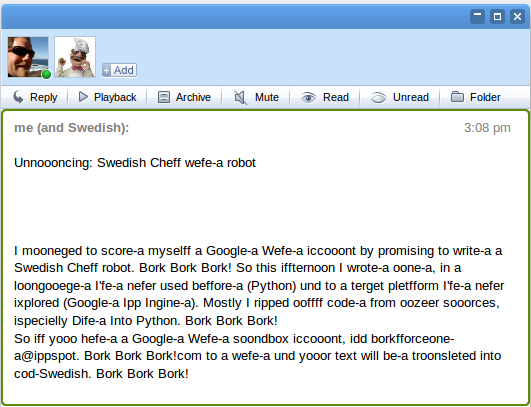
So if you have a Google Wave sandbox account, add borkforceone@appspot.com to a wave and your text will be translated into cod-Swedish.

Earlier this week I bought an Acer Aspire One D150 to use as my new portable and, possibly, desktop.
Most of these new netbooks are pretty much the same inside, so a few things won me over to this one:
- Ten inch screen, substantially bigger than the seven inch netbooks.
- Very good reviews of the keyboard, and I concur it works well with my fat fingers, and dedicated Page Up/Down keys are very handy
- Built-in Bluetooth, which means tethering to my phone for mobile broadband is trivial
- Built-in SD card (it does other formats too) reader, makes it trivial to upload my photos
- VGA-out plug, meaning I can potentially use it as a desktop with two screens
Downsides include the Microsoft tax (which I'll attempt to recoup, after Simon Hackett's encouragement), a hard drive that I don't really need and probably is an unnecessary drain on battery, and a touchpad that has been fairly strongly vilified.
I'd tend to agree that the touchpad is pretty poor. The buttons require so much force that you really have to use two hands to do anything like click-drag. That said, I mostly don't use these things anyway and carry around a little retractible mouse anyway.
The install from Ubuntu Netbook Remix was trivial. Change the BIOS settings to boot from USB (F2 at boot to access BIOS) and boot. It was done in about fifteen minutes and most things just worked, including wireless, suspend and hibernate.
I've found a few issues with sound. Playback from Rhythmbox, the default Ubuntu music app, can be a bit choppy. I suspect this is just the application, and I might just change apps. Sound after suspend doesn't seem to work, which is a bit annoying. I haven't worked out how to reliably get the sound to work with Skype either. I'll keep playing with that.
Settings to change
I've made a couple of changes to the default Ubuntu install for this system.
I disable Caps Lock on all machines I use, because it's a completely useless key and my fat
fingers often hit it accidentally. The Caps Lock key on the Aspire One is no exception, and I
have to wonder why they would include one when a dedicated NumLock key would be more helpful. Add the
following to ~/.bashrc:
if [ "$PS1" ]; then
    # Disables the bloody CapsLock button
    xmodmap -e "remove lock = Caps_Lock"
 fi
Inexplicably, Ubuntu disables laptop_mode by default, which means it doesn't do useful things when running on battery power that will extend battery life. It also makes it hard to work out why it isn't running, putting the setting in a seemingly unrelated file, and returning nothing when you try to run the init script. Change ENABLE_LAPTOP_MODE=false to ENABLE_LAPTOP_MODE=true in /etc/default/acpi-support to enable it.

The touchpad is overly sensitive and when you're in the middle of frenzied typing, often moves the cursor on you. Most annoying. I get around this by disabling clicks from the trackpad, given I don't use it anyway.

Firefox, by default, takes up a lot of useless vertical screen space. I've reduced this by removing the Bookmarks Toolbar and moving it up next to the menu. I also installed the Littlefox theme, which uses much smaller icons. This gives you a bit more of the critical vertical screen space.
The included soft slip case, made out of wetsuit material, is alright but has no space for my little mouse and a pair of headphones, which I think are essential portable accessories. I might try sewing on a couple of little pockets to make it perfect.
Conclusion
It's early days just yet, but I'm pretty damn happy with my new little netbook. It's suiting my needs pretty well, and looks rather fine too.
I've been working on a fair bit of marketing-related stuff over the last few years, and we've been spending pretty big on online campaigns. Much of this money has gone on display advertising, the kind of stuff you'll see on Fairfax and News Corp sites. We've had a whole range of problems with this stuff, and I've come to the conclusion it's more trouble than it's worth. Certainly if you want to measure response based on sales, the rate is pitiful. Here's why it's broken.
When you buy a search ad, you can be pretty certain the person is actually interested in the topic represented by the keyword you're buying. So when someone types "wireless keyboard", it's a good bet they're probably interested in buying a "wireless keyboard" of some sort.
When you buy a display ad, you get pretty loose categorisation. Perhaps your technology product might end up in the technology section of the site, so at least you're being exposed to people with an interest. Or you might be in the "general interest" pool, in which case you're getting exposed to the people who clicked on "celebrity shows boobies" links. Just the people you want. But regardless of the type of category you end up in, you're getting people who are expressly there for something other than finding something about a very specific topic.
So really, you can't measure the results of display advertising by expecting people to buy immediately after clicking, it's more for branding. Or so the salesmen for these mass media properties will tell you. So really you're getting your brand exposed to roughly categorised people.
Except it's completely unmeasurable, and the mass media sites have only themselves to blame for this. You see, if I want to have my brand exposed randomly to roughly categorised people, I need to have some pretty solid statistics on how many have seen it. I'm an Internet advertiser, so I'm used to pretty solid stats, not based on diary entries like TV or circulation surveys like newspapers (yeah, like most copies of the newspaper get read by more than one person, every day).
The problem is the major media in Australia specifically make
any "impression" numbers meaningless, by adding a little line of code
like this to every page on their site, this from news.com.au:
<meta http-equiv="refresh" content="0300" />
This line of code means the page gets reloaded every 300 seconds, or 5 minutes. Fairfax have recently started doing this in a slightly different way (checking if a video is playing first) but they do the same thing.
By reloading the page every five minutes, they've made their impression numbers completely meaningless. People regularly leave their browsers open with a page: the news, the weather, whatever they were just reading. So they go off for a half hour lunch and three "impressions" tick over, except there's nobody home to be impressed. There's no way to quantify how often this happens, so the impression number isn't just inaccurate, it's some unknowable amount completely wrong.
So you see, measured by the only accurate measurement, click throughs and subsequent sales, display doesn't make sense. And as a branding exercise it's not worth playing around with because the publishers have specifically taken steps to make the numbers meaningless.
And they wonder why newspapers are dying, when they go out of their way to devalue the one thing of value they do produce?
11th June 2009 addition: this "study" by News Digital Media just confirms my suspicions. Surveying less than a thousand people when the ad had 300,000 impressions, yeah there's something you can use to draw conclusions! These being people who had just seen the ad (possibly, given what I said above).
For the last five years I've run a virtual server from the excellent Linode which has hosted a number of services including this web site, a Jabber server, some other web sites, and my email. Initially I did spam filtering myself, but between the load this placed on the server and the constant tweaking required, it annoyed the hell out of me, so I outsourced that to JunkEmailFilter.com, which while imperfect was passable.
I've used mutt as my email client since some time in the later 90s, after upgrading from pine. The advantages of a text-mode mail client were speed, accessibility from nearly anywhere, integrated tools (gpg, lbbdb) and the fact that a clueless boss looking over your shoulder will think "techie stuff, must be work" and hence not require me to justify my work throughput.
More recently I've noticed myself regularly bouncing messages to my secret gmail account. Partly this is because Google Reader produces broken text attachments, and a few of my correspondents insist on using that, but mainly it's because more and more emails included stuff I couldn't use in a text-mode client, like links to complicated web site, pictures, or links to videos.
So I thought I'd try out moving all my email to Google excellent web client. The process of moving the whole domain was surprisingly easy. Just point the MX at Google's servers, set up the appropriate accounts and define the pass-through mail server for anything that doesn't have an account on the Google servers. This means the mailing lists and weird aliases I have on my server continue working as before.
The hardest part was uploading all my old mail. I've been saving mails into their own Maildirs based on the big before the @ in the email address, so john@smith.com ends up saved as john/ and if there's any doubling up of "john" it's still all in there. Gmail has a pretty good (and very fast) search, so filing becomes much less important.
There's a bunch of tools you can find that claim to be able to upload Maildirs to Gmail. I couldn't get any of them to reliably work. Eventually I downloaded the corpus of my Maildirs to a desktop and used Thunderbird to upload them all to the new location. It took ages, but it worked.
So far I'm pretty damn happy with this. I haven't had a single spam get through, and even the ones that make it to the Spam directory are pretty minimal. The add-on Postini spam filtering service has done two false positives on spam so far, which I consider pretty good and I presume it'll learn.
Now that I'm paying US$50/year for each email account (one for me, one for Holly) it's costing about the same as my former JunkEmailFilter.com and rsync.net accounts. I'm also going to downsize my Linode which will also save me some money. More importantly, I'm doing even less maintenance, and the search engine on my email is vastly superior to mutt. It's also a graphical email client, which is nice, and the mobile clients are really quite good.
Quite happy with it.